Why Rental Housing Now Dominates New Construction in Halifax
Nov 27, 2026
Why Rental Housing Now Dominates New Construction in Halifax
Halifax Market Insight | November 2026
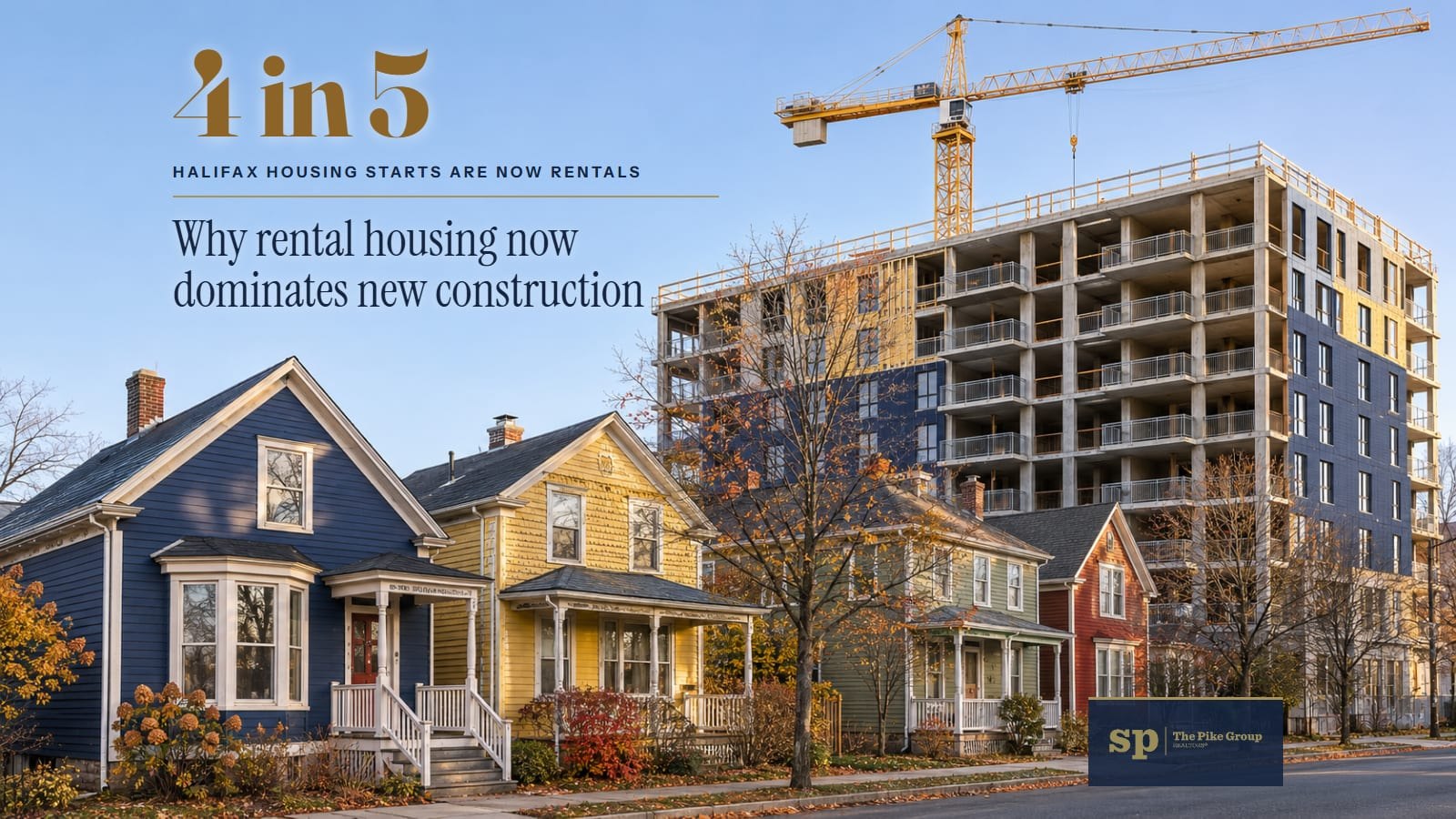
Nearly four in five new housing starts are purpose-built rentals. For Halifax owners, investors and buyers, the shift carries real implications.
Executive Summary
- As of October 2026, close to 80% of housing starts in Halifax are for the rental market, according to Canada Mortgage and Housing Corporation (CMHC) data reported by CBC News.
- The balance has moved decisively. A decade ago, ownership and condominium projects still represented 45% of starts.
- Four forces explain the shift: low-cost federal financing for rental developers, a municipal push toward density, a condominium model that has lost its footing, and an ownership affordability gap.
- The result is a pipeline rich in apartments and thin in new homes for owner-occupiers, which has meaningful consequences for the existing resale market.
The Shift in Context
Rental share of Halifax housing starts (approximate)
Ten years ago · Rental 55% / Ownership & condo 45%
October 2026 · Rental nearly 4 in 5
Illustrative. Prior-decade share derived from the 45% ownership/condo figure; current share shown as nearly four in five. Source: CMHC, as reported by CBC News (Nov. 26, 2026).
| Indicator | Figure | Source |
| Rental share of housing starts, October 2026 | Nearly 4 in 5 | CMHC |
| Ownership and condo share of starts, one decade ago | 45% | CMHC |
| Condominium starts, past four years | 144 (none in 2026 to date) | CMHC |
| Benchmark single-family price, Halifax-Dartmouth, October 2026 | $570,300 | CREA |
Four Forces Behind the Rental Pivot
1. Capital follows the lowest-risk path
Nova Scotia's construction industry points first to financing. Federal programs, notably CMHC's Apartment Construction Loan Program, have placed hundreds of millions of dollars of low-cost lending into Halifax projects. Access to that capital reduces the financial risk of building rentals, and developers respond rationally to the incentive.
2. Municipal planning favours density
For the past six to ten years, Halifax has pursued greater density. A Dalhousie planning scholar notes that this direction shapes what gets built, and the visible result is mid-rise concrete construction. Dense, multi-unit buildings are the format best suited to the rental model.
3. The condominium model has lost its footing
Only 144 condominium units have started in four years, and none this year. Lenders typically require a threshold of pre-sales before releasing construction financing. When buyer appetite is soft, that threshold becomes difficult to reach, and the cost of holding a site accumulates in the meantime. Industry observers report that some completed condominiums have been converted to rentals, while other projects have been delayed or cancelled.
4. Ownership has moved out of reach for many households
The CREA benchmark for a single-family home in Halifax-Dartmouth reached $570,300 in October, more than double the level of a decade ago. Beyond the purchase price, buyers must assemble a substantial down payment and absorb closing costs such as legal fees. Some households have stepped back from ownership altogether, while others who would otherwise transition from renting to buying are doing so more slowly.
A Mismatch Worth Watching
Planners report a gap between what is being built and what many Nova Scotians still aspire to. Home ownership remains a deeply rooted cultural expectation, even as policy and financing steer construction toward purpose-built rental.
Many planners see "missing middle" housing, including townhouses and multiplexes, as a bridge. These forms deliver density and its infrastructure and emissions benefits while adding supply for both renters and owners.
What This Means for Halifax Owners, Investors and Buyers
Homeowners. A new-build pipeline weighted so heavily toward rental apartments means comparatively limited fresh supply of ownership product. Well-maintained existing homes, particularly freehold and townhouse formats, compete in a market where new alternatives for owner-occupiers are scarce.
Investors. Policy and capital are aligned behind purpose-built rental, which signals institutional confidence in long-term rental demand. It also means new rental supply is arriving, so location, building quality and pricing discipline matter more than ever.
Buyers. The affordability barrier is as much about savings and closing costs as monthly payments. Early planning around the down payment and total acquisition cost is the most effective way to move from renting to owning.
The balance between rental and ownership supply will shape Halifax's housing market for years. If you are weighing a sale, a purchase or an investment decision, a property-specific view is far more useful than headline figures.
Sources: Housing start data from Canada Mortgage and Housing Corporation (CMHC); benchmark pricing from the Canadian Real Estate Association (CREA); both as reported by CBC News, "Why the large majority of new housing construction in Halifax is for the rental market," Andrew Lam, November 26, 2026. This commentary is for general information and does not constitute financial or investment advice.
Authored by Sandra Pike, REALTOR® | The Pike Group, Royal LePage Atlantic
One of Halifax's Top Resale Listing Agents Since 2016 | Data-Driven Market Insights and Real Estate Commentary